Andrew Perkins presents paper at International Journal Of Clinical Legal Education 2025 Conference In Melbourne

TBLS Assistant Director Andrew Perkins recently returned from the International Journal of Clinical Legal Education (IJCLE) 2025 Conference, held at Monash University in Melbourne from 19–21 November 2025.

This year’s conference theme, “Navigating Global Challenges in Clinical Legal Education: Innovating for the Future,” brought together clinical academics and practitioners from around the world to explore emerging issues in legal education and access to justice.

Andrew participated in workshops addressing key areas of contemporary clinical practice, including effective supervision frameworks, the integration of AI tools within clinic environments, and enhanced methods of student reflection. His contributions were grounded in his experience supervising the Cayman Islands Legal Assistance Clinic.

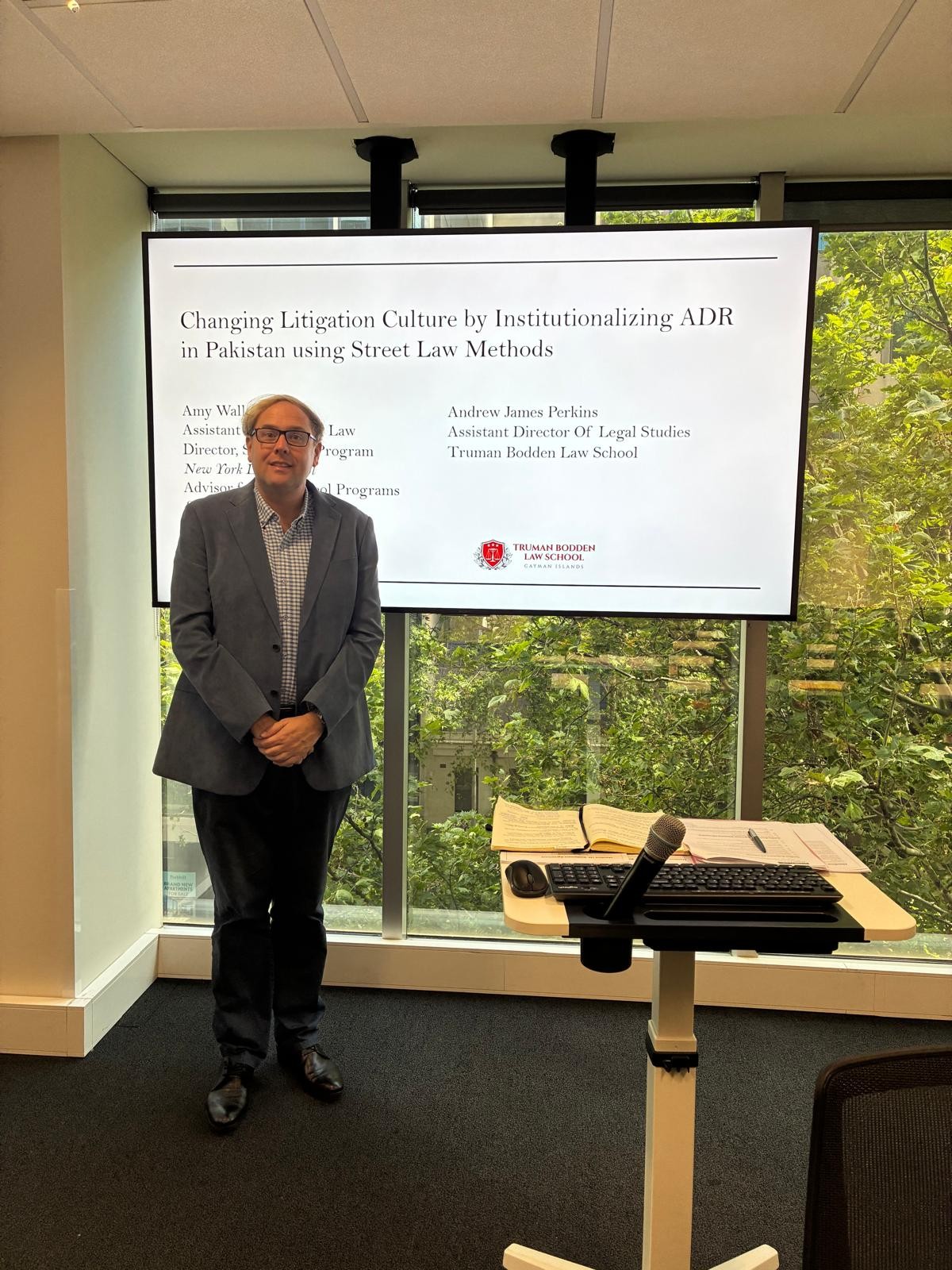
In addition, Andrew co-facilitated an interactive workshop with Professor Amy Wallace of New York Law School, drawing on their forthcoming article in the George Washington International Law Review, “Changing Litigation Culture by Institutionalising ADR in Pakistan Using Street Law Methods.” Their session provided an overview of the project’s objectives and methodology, followed by a hands-on Negotiation Skills workshop for conference attendees.

Andrew and Amy will return to Pakistan in December 2025, where their ADR/Street Law course will be implemented as a compulsory module within the LL.B qualification for all law schools. The rollout is being led by the Directorate of Legal Education with the support of the Legal Aid Society of Pakistan

TBLS Director Mr. Mitchell Davies BEM stated that “It is fantastic to see TBLS staff collaborating with world-leading universities and clinicians to produce internationally impactful clinical legal work here in the Cayman Islands.” Further information about this project can be obtained from Andrew on andrew.perkins@gov.ky

0
0

TBLS Students and Faculty Shine in the American Caribbean Law Initiative (ACLI) Conference

TBLS played an active role in the 2025 American Caribbean Law Initiative (ACLI) Conference, held 5–7 November at the Stetson University College of Law in Tampa.

The ACLI Conference is a key regional clinical legal education initiative whose mission is to  develop advocacy skills and brings together member law schools from the Caribbean and the United States.

During the period November 5-7, TBLS second year LL.B students Sarah Bergstrom and Marysia Cyfko represented TBLS in student moots and related preparatory activities.

Sarah BERGSTROM delivering her presentation at ACLI

Sarah BERGSTROM delivering her presentation at ACLI

Sarah and Marysia worked with their peers from other participating law schools to produce exceptional legal opinions, demonstrating analytical rigour, professionalism, and strong teamwork.

Marysia CYFKO delivering her presentation at ACLI

Marysia CYFKO delivering her presentation at ACLI

The November ACLI meeting addressed a broad range of legal issues affecting the Caribbean–US region, including constitutional development, access to justice, immigration rights and freedom of expression.

The moot court and preparatory sessions offered participants a structured environment to engage with real-world legal problems, apply comparative legal analysis, and exchange perspectives across jurisdictions.

ACLI moot judges Phyllis KOTEY Laura PANADES and Erica CUMMINGS

ACLI moot judges Phyllis KOTEY, Laura PANADES and Erica CUMMINGS

TBLS Lecturer Laura Panades participated as both a student coach and a judge in the conference’s moot student presentations. Laura supported Sarah and Marysia in their preparatory work, and assessed the legal reasoning and advocacy skills of all students.

Mitchell Davies, TBLS Director, also attended the ACLI, having been a key player in the early evolution and development of the ACLI initiative. Through the years, Mr Davies has been a valuable member of the ACLI’s Board, and a strong supporter of the initiative which has contributed to the advocacy skills development of generations of TBLS students.

TBLS representation at the ACLI 25 Anniversary Dinner

TBLS representation at the ACLI 25 Anniversary Dinner

This year, the ACLI also celebrated its 25th anniversary, with a recurring theme being how the involvement of the member law schools in the initiative has been key in developing advocacy and legal research skills and regional engagement across borders.

The ACLI’s members include Eugene Dupuch Law School (Bahamas); Hugh Wooding Law School (Trinidad and Tobago); Norman Manley Law School (Jamaica); and Nova Southeastern University Shepherd Broad Law Center, Stetson University College of Law, and Florida International University College of Law in the United States.

As ever, this activity received the generous support of the Portfolio of Legal Affairs.

Mitchell Davies, Law School Director, said:

‘As TBLS Director, it is my pleasure to have been involved in this unique regional clinical legal education initiative since soon after its inception.

‘Through this unique collaborative experience, participating students learn valuable advocacy training skills which contribute to their legal education development and complement their academic skills.’

Laura Panades, student coach and moot judge, noted:

‘Initiatives like the ACLI allow TBLS to showcase the excellence of our student community.

‘The ACLI yields high added value for participating students, in preparing them for team work, networking and navigating common, regional legal challenges in a collaborative environment.’

FURTHER INFORMATION

Laura Panades

Laura.Panades@gov.ky

4
0

Attorney General welcomes new book on Cayman land law

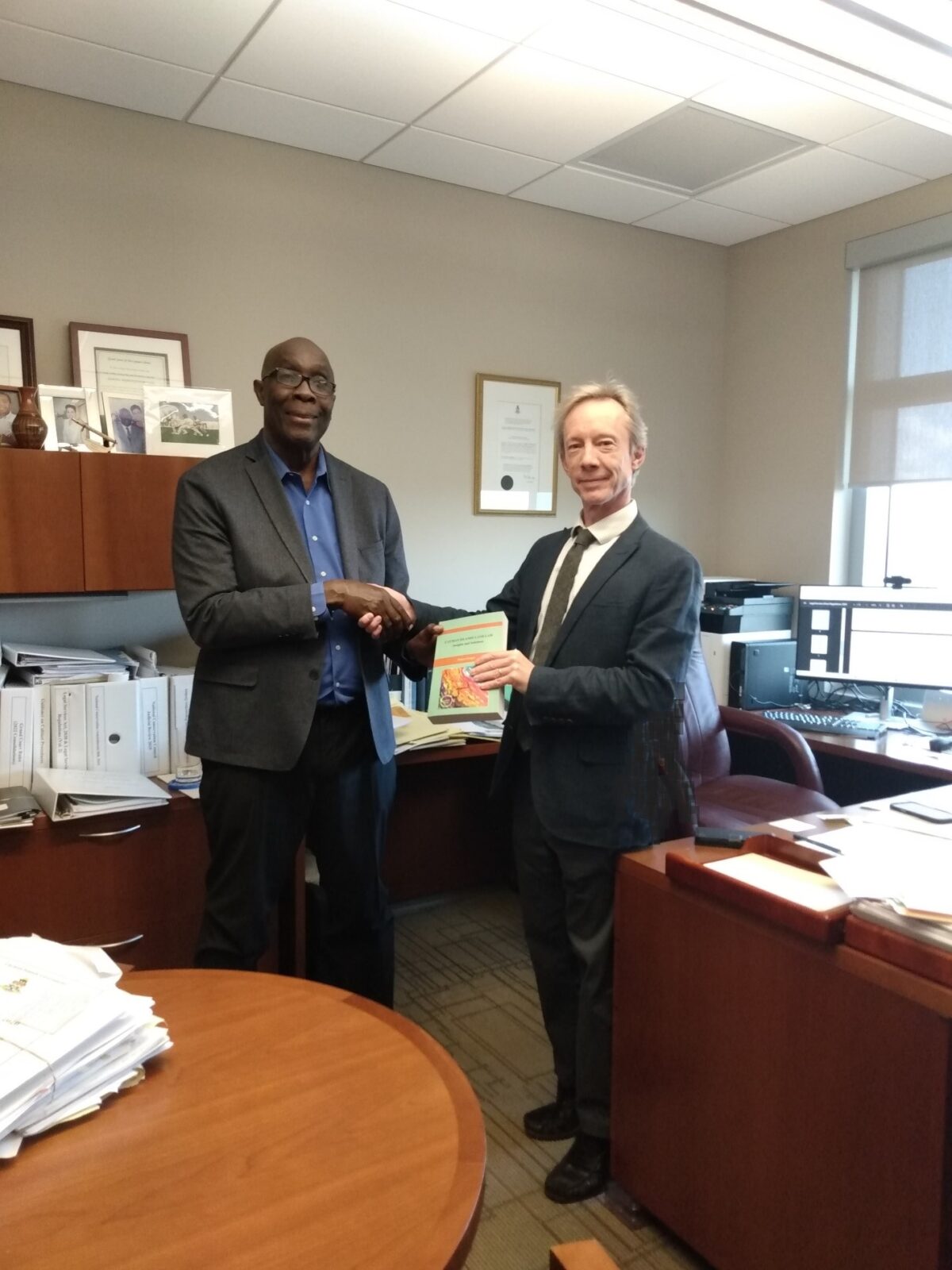
The Hon. Samuel Bulgin KC, Attorney General, met with Professor Simon Cooper to congratulate him on authoring a new book on Cayman law.

The book is titled ‘’Cayman Islands Land Law: Insights and Solutions’’. It covers 23 selected topics which the author identified as causing difficulties in law or practice. They range across a wide variety of different areas, including the following:

– the reliability of the land register in special cases

– developing strata schemes in phases

– powers of guardians over children’s land

– beach access rights

– road closures

– and many more

The Attorney General expressed his appreciation for the new book:

“I am very pleased to welcome this new addition to the limited number of publications on Cayman law. This book will bring the benefit of Professor Cooper’s academic scholarship to a wider audience. It has in-depth analysis of some real-life concerns that affect land rights and dealings with land.”

“This work is distilled from Professor Cooper’s years of experience in land law in Cayman and the other British Overseas Territories. It represents a notable enrichment for the Cayman Islands legal system, and will be valuable to everyone who wants to think more deeply about issues in land law.”

Professor Cooper arrived in the Cayman Islands over 30 years ago. He has spent a career analysing and writing on law in the Cayman Islands. He teaches at the Truman Bodden Law School.

Professor Cooper explained his approach to writing the book:

“I took the opportunity to single out some areas of land law which I identified as particularly problematic. I work through a detailed study of them and I propose possible solutions. This could be potentially useful to legal practitioners looking for further resources in understanding the law or putting forward well-informed arguments about controversial points.”

“I hope it will also assist as a foundation for future reforms to improve the land law in Cayman.”

Professor Cooper is a lawyer and academic specialising in property. He writes the main textbook on property transactions in the UK which is used by lawyers and judges. His scholarly articles and reports have been actioned in law reforms in the British Overseas Territories and the UK. He has been commissioned to run government inquiries into property matters, and has advised the United Nations on land policy in the Caribbean.

1
0